
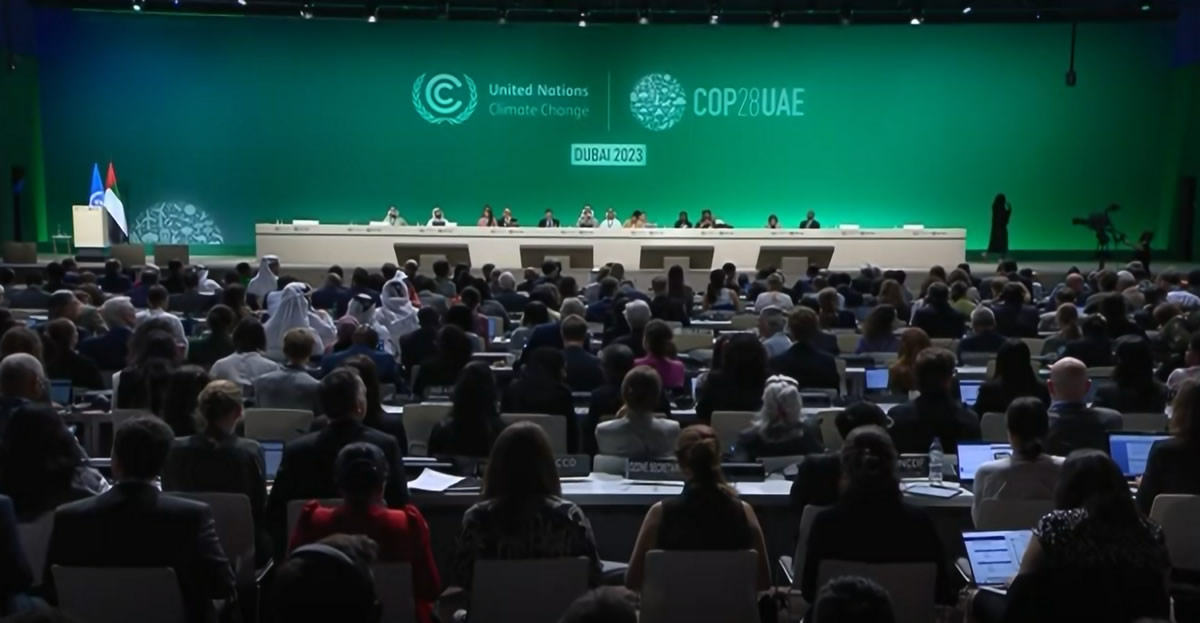
Throughout the recent COP28, the Insurance Development Forum (IDF) contributed to the discussions and advocated for the critical role of insurance in addressing the climate crisis. The organization says that during the event IDF and its partners ‘witnessed a groundbreaking shift in the recognition of the role of insurance in strengthening resilience and adaptation’.
For the IDF, COP28 served as a pivotal moment, reflecting the organization’s commitment to drive resilience and adaptation through leveraging insurance and its related risk management capabilities. The IDF pursued three core objectives during the conference:
Showcasing Solutions: the IDF spotlighted various initiatives, including country-led implementations through the Tripartite Agreement, support for the Global Shield against Climate Risks, and launch of the IDF-convened Resilient Planet Data Hub. These initiatives demonstrate tangible solutions for tackling the climate crisis.
Building Partnerships: IDF representatives actively engaged in open dialogue, hosting roundtables, joining panel discussions, and engaging in multiple bilaterals that fostered partnerships with governments, industry members, and partners across civil society, academia, and international organizations.
Shaping Public Policy: the IDF played a key role in shaping public policy through jointly hosting/convening over 25 events, including high-level discussions on early action, financial strategies, and partnerships for development.
IDF states that as a result of the above it has been able to deliver and support the following developments during COP28:
Risk analytics
- Contributing to the operationalization of the Global Shield against Climate Risks with the Global Risk Modelling Alliance (GRMA) programme, with Ghana highlighted as an in-country ongoing success story and sharing their experiences so far. The Global Risk Modelling Alliance (GRMA) was initiated by the IDF industry members and implemented in partnership with the Vulnerable 20 Group of Finance Ministers of the Climate Vulnerable Forum (V20) and German Federal Ministry for Economic Cooperation and Development (BMZ). This programme, initiated by the IDF and continuously supported by industry members – AIG, Aon, AXA, AXIS Capital, Convex, RenaissanceRe, SCOR, Guy Carpenter, and Howden – provides access to insurance risk analytics expertise to help develop risk insight in climate-vulnerable countries. The GRMA’s work in Ghana showcased the value of working with the IDF and GRMA to fill risk information gaps, and how risk insight can be deployed for the protection of property and livelihoods in both urban and rural regions.
- Announcement of The Resilient Planet Data Hub (RPDH), an open, resilience data service developed by the Global Resilience Index Initiative. Founded by the IDF, University of Oxford and UN Office for Disaster Risk Reduction, the RPDH was developed to fix the information gap in the face of climate and disaster risks under the UN headings of People, Planet and Prosperity. The RPDH is a completely open resource, and is the first tangible component of the wider Resilient Planet Initiative led by the UN Climate Champions. The RPDH includes access to the Global Resilience Index Risk Viewer, a portal offering multi-hazard, globally consistent risk and resilience data under current and future climate conditions. It also offers detailed case studies to demonstrate real-world application for users in sovereign governments, financial institutions, investors and regulators.
Financial protection
- Country representatives from Colombia, Ghana and Nigeria shared their experiences with the IDF, UNDP and BMZ Tripartite Programme at different sessions during COP28, highlighting its relevance to issues from food security to disaster preparedness and more. The Inclusive Insurance Roadmap Initiative in Kenya was also showcased as part of the country-led work under the Tripartite programme.
- The Tripartite Programme is an unprecedented partnership between the insurance industry and the United Nations. The Tripartite programme has successfully rolled out projects to scale up climate and disaster risk finance and insurance solutions for poor and vulnerable people in more than 20 countries, with expected beneficiaries of minimum 64 million, all underpinned by an offered risk-capacity of US$ 5 billion from the IDF’s insurance industry members.
- Supporting the efforts of public sector partners who announced commitments to pre-arranged financing, including premium financing support for vulnerable countries.
- Engaging with the Humanitarian community and showcasing innovative programmes with START Network, and others and where insurance capabilities are being deployed and leveraged in innovative ways to reach those who are already at the forefront of the climate crisis.
Advocacy and engagement
In line with efforts to continue to shape policy, the IDF also supported the:
- Call to action: Getting Ahead of Disasters: Launch of a Charter on Finance for Managing Risks
- Call for Collaboration: Enhancing the enabling environment to accelerate the mobilisation of private finance for adaptation and resilience supported by the Government of Austria, the Government of Chile, the Government of Colombia, the Government of Guatemala, and the Government of Switzerland.
And contributed toward the following reports:





