
Researchers have found that interplanetary shocks which strike Earth’s magnetic field head-on cause more powerful ground-level electric currents, increasing the threat to critical infrastructure. This provides an opportunity to forecast dangerous shocks and shield critical infrastructure, according to a new open access paper published in the Frontiers in Astronomy and Space Sciences journal.
“Auroras and geomagnetically induced currents are caused by similar space weather drivers,” explained Dr Denny Oliveira of NASA’s Goddard Space Flight Center, lead author of the paper. “The aurora is a visual warning that indicates that electric currents in space can generate geomagnetically induced currents on the ground.”
“The auroral region can greatly expand during severe geomagnetic storms,” he added. “Usually, its southernmost boundary is around latitudes of 70 degrees, but during extreme events it can go down to 40 degrees or even further, which certainly occurred during the May 2024 storm — the most severe storm in the past two decades.”
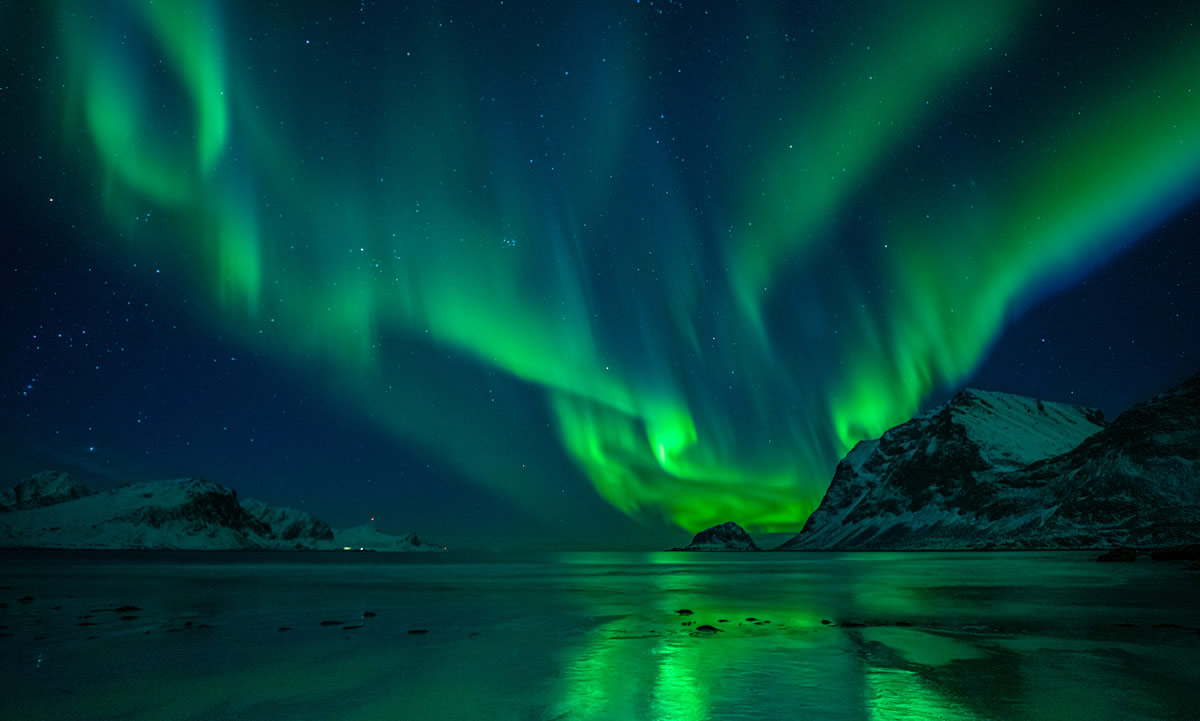
Auroras are caused by two processes: either particles ejected from the sun reach Earth’s magnetic field and cause a geomagnetic storm, or interplanetary shocks compress Earth’s magnetic field. These shocks also generate geomagnetically induced currents, which can damage infrastructure that conducts electricity. More powerful interplanetary shocks mean more powerful currents and auroras — but frequent, less powerful, shocks could also do damage.
“Arguably, the most intense deleterious effects on power infrastructure occurred in March 1989 following a severe geomagnetic storm — the Hydro-Quebec system in Canada was shut down for nearly nine hours, leaving millions of people with no electricity,” said Oliveira. “But weaker, more frequent, events such as interplanetary shocks can pose threats to ground conductors over time. Our work shows that considerable geoelectric currents occur quite frequently after shocks, and they deserve attention.”
Shocks which hit the Earth head-on, rather than at an angle, are thought to induce stronger geomagnetically induced currents, because they compress the magnetic field more.
Researchers, led by Oliveira, investigated how geomagnetically induced currents are affected by shocks at different angles and times of day.
To do this, they took a database of interplanetary shocks and cross-referenced it with readings of geomagnetically induced currents from a natural gas pipeline in Mäntsälä, Finland, which is generally in the auroral region during active times. To calculate the properties of these shocks, such as angle and speed, they used interplanetary magnetic field and solar wind data. The shocks were divided into three groups: highly inclined shocks, moderately inclined shocks, and nearly frontal shocks.
The researchers found that frontal shocks cause higher peaks in geomagnetically induced currents both immediately after the shock and during the following substorm. Particularly intense peaks took place around magnetic midnight, when the north pole would have been between the sun and Mäntsälä. Localized substorms at this time also cause striking auroral brightening.
“Moderate currents occur shortly after the perturbation impact when Mäntsälä is around dusk local time, whereas more intense currents occur around midnight local time,” said Oliveira.
Because the angles of these shocks can be predicted up to two hours before impact, this information could allow organizations to set in place protections for electricity grids and other vulnerable infrastructure before the strongest and most head-on shocks strike.
“One thing power infrastructure operators could do to safeguard their equipment is to manage a few specific electric circuits when a shock alert is issued,” suggested Oliveira. “This would prevent geomagnetically induced currents reducing the lifetime of the equipment.”





