
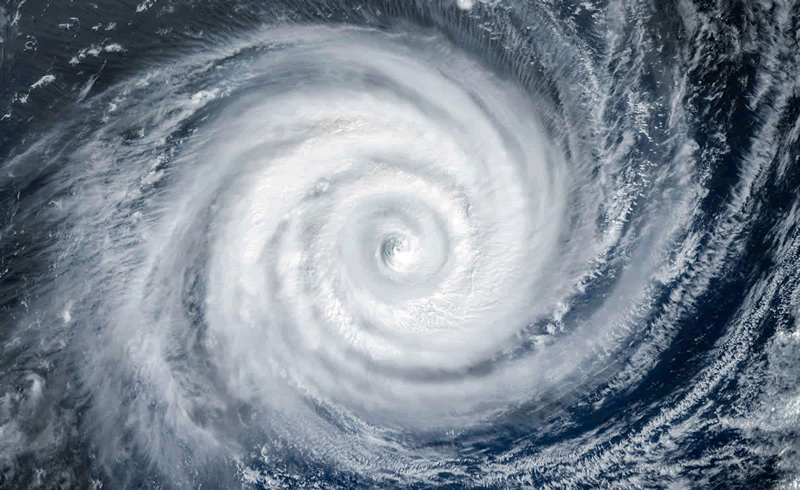
The Saffir-Simpson Windscale is used to label a hurricane on a scale from Category 1 to Category 5. Now climate scientists are suggesting that it may need updating to account for the potential for hurricanes beyond Category 5.
Climate scientists Michael Wehner of Lawrence Berkeley National Laboratory (Berkeley Lab) and James Kossin of the First Street Foundation make the suggestion following extensive research, the results of which have been published in the Proceedings of the National Academy of Sciences (PNAS). The paper, ‘The growing inadequacy of an open-ended Saffir–Simpson hurricane wind scale in a warming world’, introduces a hypothetical Category 6 to the Saffir-Simpson Wind Scale, which would encompass storms with wind speeds greater than 192 mph.
“Our motivation is to reconsider how the open-endedness of the Saffir-Simpson Scale can lead to underestimation of risk, and, in particular, how this underestimation becomes increasingly problematic in a warming world,” said Wehner, who has spent his career studying the behavior of extreme weather events in a changing climate and to what extent human influence has contributed to individual events.
According to Wehner, anthropogenic global warming has significantly increased surface ocean and tropospheric air temperatures in regions where hurricanes, tropical cyclones, and typhoons form and propagate, providing additional heat energy for storm intensification.
When the team performed a historical data analysis of hurricanes from 1980 to 2021, they found five storms that would have been classified as Category 6, and all of them occurred in the last nine years of record. They determined a hypothetical upper bound for Category 5 hurricanes by looking at the expanding range of wind speeds between the lower-category storms.
In addition to studying the historical record, the researchers analyzed simulations to explore how warming climates would impact hurricane and typhoon intensification. Their models showed that with two degrees Celsius of global warming above pre-industrial levels, the risk of Category 6 storms increases by up to 50% near the Philippines and doubles in the Gulf of Mexico and that the highest risk of these storms is in Southeast Asia, the Philippines, and the Gulf of Mexico.
Tropical cyclone risk messaging is a very active topic, and changes in messaging are necessary to better inform the public about inland flooding and storm surge, phenomena that a wind-based scale is only tangentially relevant to. While adding a 6th category to the Saffir–Simpson Hurricane Wind Scale would not solve that issue, it could raise awareness about the perils of the increased risk of major hurricanes due to global warming.
James Kossin





