The DRI 2025 Risk and Resilience Trends Report was published recently. The report, now in its eleventh year, uses results from a global survey to review the top risks, threats, and strategic issues that industry professionals have encountered over the past year, and considers how organizations should improve their resilience going forward. This year’s report also contains a deep delve into cyber security – as this has remained the top risk for the past four years.
The global risk landscape in 2025: a year shaped by conflict, digital security, and climate crises
Overall, the 2025 global risk landscape was shaped by intertwined geopolitical, environmental, economic, and technological shocks. The central challenge in 2025 for governments and organizations alike lay in balancing immediate security and cost-of-living pressures with longer-term investment in climate adaptation, digital resilience, and social protection.
For practitioners, concerns naturally circle around risks that directly concern their organizations, whereas analysts in the World Economic Forum (WEF)’s Global Risks Report 2025 ranked state-based armed conflict and great-power rivalry as the dominant short-term hazards, with escalating wars and deepening trade fragmentation raising the risk of an unstable economic environment, political instability, and cross-border spillovers.
Another key risk which came to the fore in 2025 was climate risk. The pressure intensified as temperatures edged beyond the Paris Agreement’s 1.5°C ambition; the UN Emissions Gap Report 2025 projected overshoot, and the year also saw more frequent weather extremes, from Southern Europe’s heatwaves to major flooding in South Asia. In addition, technological vulnerabilities also widened: artificial intelligence (AI)-enabled cyber attacks disrupted critical infrastructure, while coordinated disinformation campaigns affected elections in multiple regions.
How does this compare to practitioners’ views? Remarkably closely, in fact. While armed conflict and terrorism still rank low in the list of organizational disruptions in the 2025 DRI Risk and Resilience Trends report, changing alliances and geopolitical conflicts are one of the five key strategic risks highlighted by the DRI Future Vision Committee (FVC). There are concerns about ongoing global stability, the rise of cyber-related warfare, and, in some cases, the physical and human consequences of conflict on workforce and their families. This can lead to corporate uncertainty because of unpredictable demand, heightened credit risks, and retreating investment.
Cyber risks, a key theme of global risk reports over the past year, is also the greatest threat to businesses over the past year according to the DRI survey. It has remained in first place for the past four years, and only briefly pushed into second place at the height of the COVID-19 pandemic in 2021 (see Table 1 below).
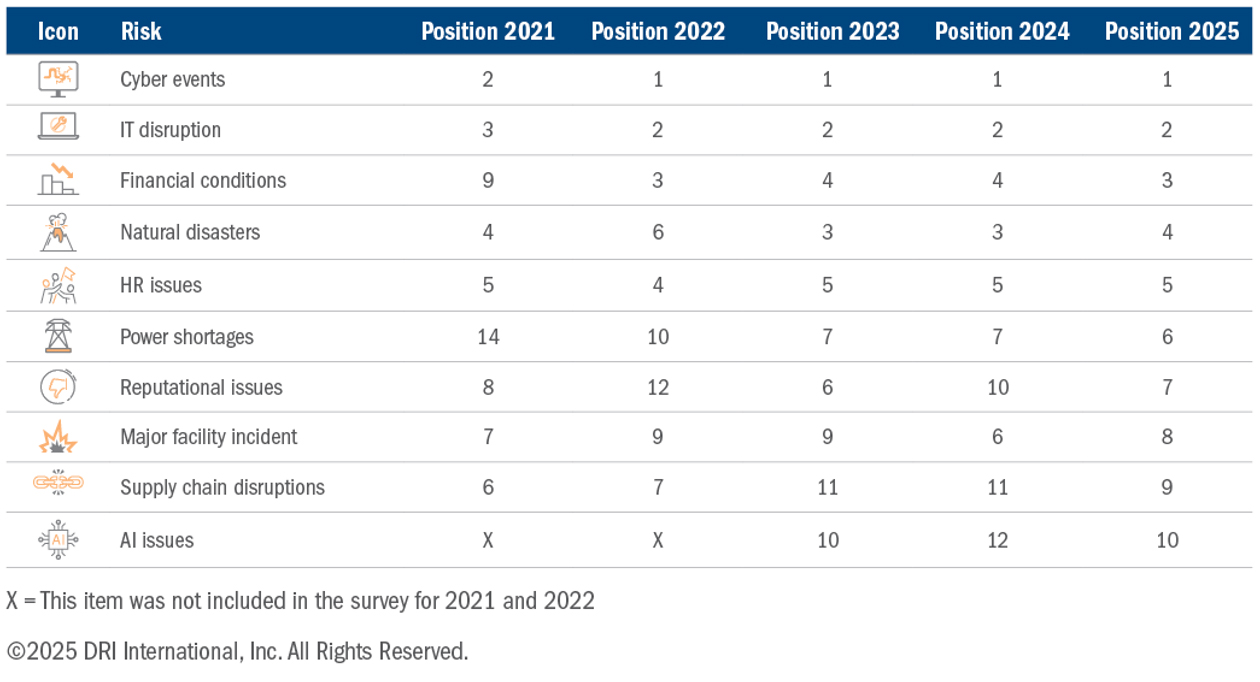
Amongst the top ten risks, there are two which have seen particular change: firstly, financial conditions (rated in ninth place in 2021) has been rising up the top ten during the past five years and is now the third greatest concern for survey respondents; tying in with the financial risks highlighted in the IMF’s World Economic Outlook. The other risk which has had a growing impact over the past four years is that of increasing power shortages. The risk sat firmly in last place in 2021 but has risen to sixth place this year. Although power shortages are not identified in many industry risk reports, their inclusion in the DRI report is as a result of the specific impact of these events on practitioners’ organizations. These power shortages, which are normally not planned, can, for example, be caused by inclement weather, increased demands for energy, damage to power generation units through malicious physical or cyber attacks, or reduction in supply due to intra-border conflicts.
Cyber security – the top threat, year-on-year
The table above shows how cyber security has remained the top risk for organizations for the past four years – something which is emulated by other corporate risk reports such as the Allianz Risk Barometer 2025. Some risks achieve particular prominence due to events that have occurred during that year (e.g. the COVID-19 pandemic), whereas the ever-evolving nature of cyber crime means that organizations have to remain on guard to both traditional and newer threats, as well new cyber attack vectors being created through the use of AI (e.g. AI-enhanced phishing and social engineering, automated vulnerability discovery, deepfake-driven impersonation, AI-powered malware and evasion). As a result, organizations have to invest in both technology and talented staff to ensure that their organization – and their customers and suppliers – are protected against cyber criminals. For the c-suite, a successful cyber attack has the potential to stop production, bring a business offline, and affect payment systems – all affecting a company’s bottom line.
Supply chain and third-party risk management – the new battleground?
COVID-19 was a reminder to the world of the fragility of global supply chains. Air transport routes were closed overnight, container ships were unable to dock, and previously successful just-in-time production strategies failed due to the loss of the ability to acquire goods quickly. While many organizations have introduced new supplier management strategies as a result of the pandemic (e.g. nearshoring, increasing safety stock, improved supplier management), another global event with a different trajectory to COVID-19 has the potential to disrupt organizations further.
The survey shows that supply chain disruption was only in ninth place in the DRI report’s risk index this year which shows the impacts felt during COVID-19 have waned – at least for the time being. However, the need for good vendor management is more critical than ever due to the exceptionally diverse and ever-changing risk landscape. The companies that perform regular due diligence on their suppliers, map their supplier base beyond their closest – tier 1 – suppliers, and carry out regular training and exercising with their critical suppliers are set to be those that thrive ahead of their competitors at the first hint of any disruption.
AI and its impact on business resilience
The impact of AI-related cyber crime has already been discussed in this article, but survey respondents reported the impact of AI on their organizations was far greater than just the threat posed by its use in cyber crime. including:
- The inaccuracy of AI in its current state.
- The possible loss of institutional knowledge when AI is used without human support.
- The risk of AI investment taking resources away from other areas, including business continuity and resilience.
- AI automating current business continuity processes and opening the company up to new risks (e.g. total automation of the BIA without human intervention or verification, data mining unverified internal and external data sources, automation of risk management processes).
Indeed, while there are advantages to adopting AI to assist with business continuity processes and procedures (e.g. datamining, supply chain analysis), for some organizations, using AI remains a challenging prospect. Therefore, should organizations hold off adoption until the technology becomes more tried and trusted, or should they risk being left behind in terms of the potential efficiency gains that AI can offer to resilience teams? Both parts of the argument need careful consideration by all parties but, at the very least, an AI-usage policy should be drawn up for an organization so all parties are clear of their own responsibilities in using the technology, the potential risks involved, and the limitations of usage within the organization.
How should practitioners be better prepared for these risks?
Overall, the best practitioners will be prepared for any incident that could affect their organization – as well as the potential impacts of incidents that are impossible to predict (the unknown unknowns). Using a risk agnostic approach ensures preparedness for all impacts, rather than just specific scenarios. For example, in an Internet blackout – regardless of cause – the processes followed to ensure critical business activities continue to run, or if staff are suddenly unable to access an office – whether through severe weather, pandemic, or fire – they are drilled in what to do if such an impact occurs.
However, in terms of the specific risks highlighted in the 2025 Risk and Resilience Trends Report, there are several steps that practitioners can take to ensure they are better protected from the threats:
Risk | How to Prepare from a business continuity and resilience perspective | Relevant DRI Professional Practice(s) |
1. Armed conflicts & global instability |
| PP2: Risk Assessment – assess external human-caused risks; evaluate impacts and controls. |
2. Unplanned power outages |
| PP2: Risk Assessment – evaluate utility failures and technology exposures. |
3. Cyber attacks |
| PP2: Risk Assessment – cyber security, data protection, controls review. |
4. Supply chain disruption |
| PP2: Risk Assessment – identify supply chain vulnerabilities and external dependencies. |
5. AI usage (operational & organizational risk) |
| PP2: Risk Assessment – evaluate technology exposures and human-resource impacts, including emerging AI risks. |
Conclusion
As this year’s Risk and Resilience Trends Report shows, the threats facing organizations are evolving, but so too are the tools, skills, and strategies available to manage them. Cyber attacks remain the dominant disruptor, yet it is the convergence of risks – geopolitical shocks, climate volatility, AI disruption, and supply chain fragility – that truly defines the resilience challenge ahead. No organization can treat these risks as isolated technical issues. They are now strategic pressures that shape culture, investment, and competitiveness.
The author
Rachael Elliott is Director of Global Strategy and Innovation for DRI International. Rachael has particular expertise in the technology side of resilience, and has a keen interest in how artificial intelligence can help to transform the resilience of organizations. Her research has been used in the UK Parliament to help develop government industrial strategy as well as in the BDO High Street Sales Tracker, which Elliott was instrumental in developing and is still the UK’s primary barometer for tracking high street sales performance. She maintains a keen interest in competitive intelligence and investigative research techniques.