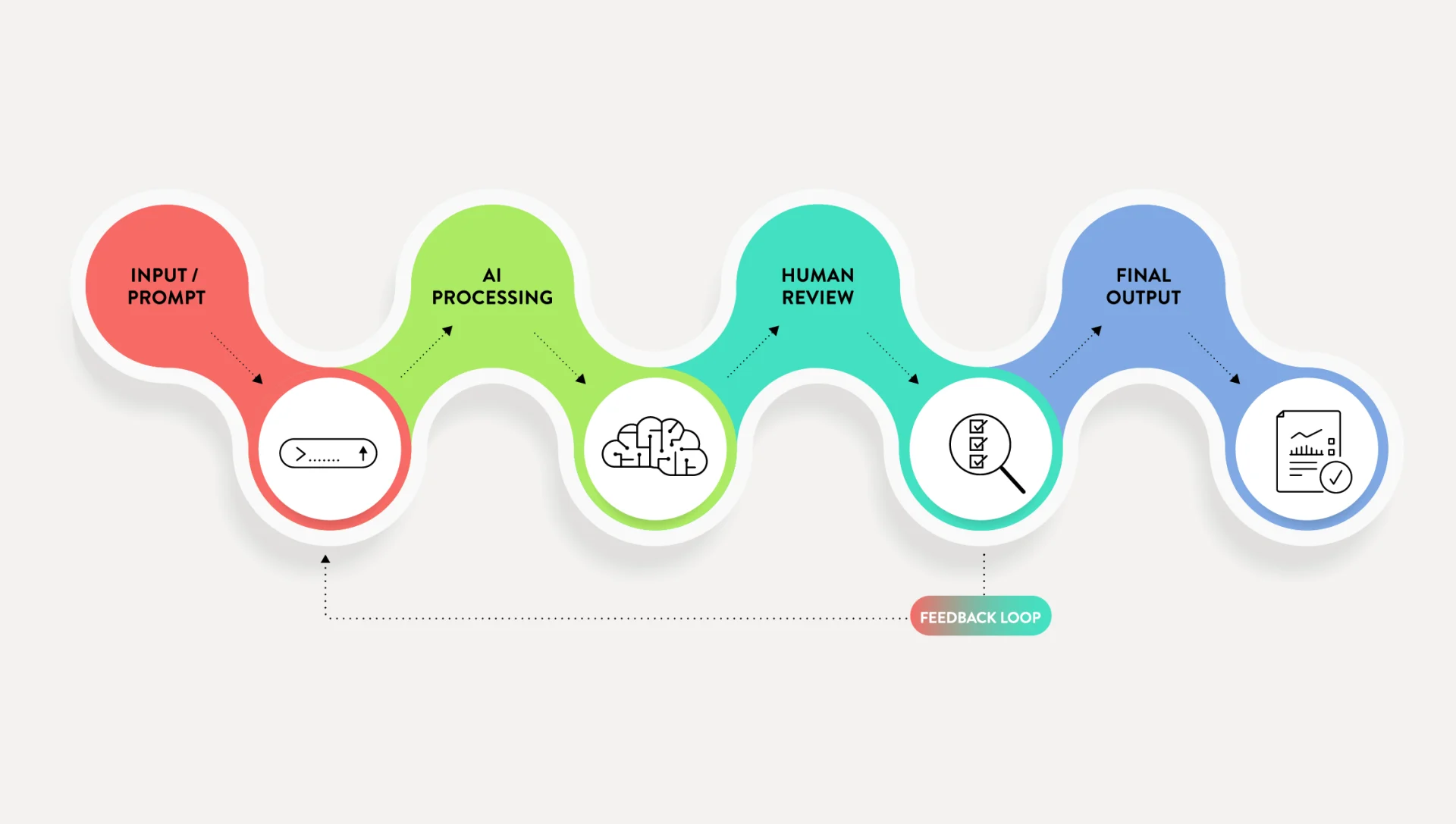
Strategic discussions about AI often centre on workforce restructuring and automation. A more immediate enterprise risk is emerging: failure to design effective human-in-the-loop (HiTL) operating models.
According to AI consultancy Datatonic, organizations that do not properly integrate AI into human workflows are experiencing stalled productivity, elongated decision cycles, and weak value realisation. Competitors adopting governed hybrid human-AI models are moving faster and converting insight into action more reliably.
Boards and executive teams enter 2026 under increasing pressure to demonstrate returns on significant AI investment. Yet research from the Massachusetts Institute of Technology, reported in Fortune, suggests that as many as 95% of AI pilots fail to deliver meaningful impact. Many remain isolated experiments, disconnected from core processes and subject to insufficient governance. As a result, AI systems may generate analysis and recommendations that are never operationalised, leaving human teams carrying equal – or greater – workload than before.
Datatonic’s experience with global enterprises suggests that the issue is rarely technical capability. Instead, it is operating-model design. The most effective AI-enabled processes are not fully autonomous; they are structured around human-in-the-loop models that combine machine speed with human judgment, accountability, and domain expertise.
One mature example is agent-assisted software development. Rather than relying on informal ‘vibe coding’, leading enterprises are moving towards specification-driven environments in which humans define and validate requirements and execution plans before AI agents build modular components at scale. This approach accelerates delivery while preserving control, traceability, and quality assurance.
Similar patterns are emerging across finance, operations, and customer workflows. AI performs preparation, analysis, and validation tasks, while humans retain oversight, exception handling, and decision authority. When properly governed, these hybrid systems compress cycle times without eroding accountability.
Datatonic advocates clear ROI definition for every AI system, linked to quantifiable business outcomes such as reduced churn, faster processing times, or measurable cost efficiencies. Performance data should be embedded directly into agent platforms, enabling leaders to monitor delivery in real time and intervene when outputs diverge from expectations.
Over the next 12 to 24 months, Datatonic anticipates enterprise work cycles compressing from weeks to hours as AI agents increasingly handle preparation and scenario testing. In some cases, agents will stress-test proposals before human teams commit capital or resources. In this environment, the primary risk will not be insufficient automation, but poorly governed integration.
For business leaders planning their next AI phase, the message is clear: move beyond replacement narratives and focus on designing governed, human-centred operating models. Without deliberate HiTL architecture, organizations risk stalled investment returns, diffused accountability, and strategic underperformance.