Close Menu
  • Home
  • Managing resilience
    • AI resilience
    • Business continuity
    • Business resilience
    • Climate resilience
    • C-suite and the board
    • DORA – the EU Digital Operational Resilience Act
    • Operational resilience
    • Organizational resilience
    • Supply chain resilience
    • Technology
  • Risk
    • Enterprise risk management
    • Operational risk
    • Threatscape
  • Cyber resilience
    • Cyber resilience updates
    • DORA – the EU Digital Operational Resilience Act
    • Product updates
More items
  • All News
  • Research
  • Jobs in Resilience
  • Resilience Resources
  • About Resilience Forward
X (Twitter) LinkedIn
  • Home
  • Managing resilience
    • AI resilience
    • Business continuity
    • Business resilience
    • Climate resilience
    • C-suite and the board
    • DORA – the EU Digital Operational Resilience Act
    • Operational resilience
    • Organizational resilience
    • Supply chain resilience
    • Technology
  • Risk
    • Enterprise risk management
    • Operational risk
    • Threatscape
  • Cyber resilience
    • Cyber resilience updates
    • DORA – the EU Digital Operational Resilience Act
    • Product updates
Login
LinkedIn Bluesky
Resilience Forward
Subscribe Now
  • All News
  • Research
  • Jobs in Resilience
  • Resilience Resources
  • About Resilience Forward
Resilience Forward
You are at:Home»Managing resilience»Climate resilience»Swiss Re Institute review highlights that flood risk is increasing in many regions around the world (Page 24)
Climate resilience

Swiss Re Institute review highlights that flood risk is increasing in many regions around the world

December 10, 20242 Mins Read
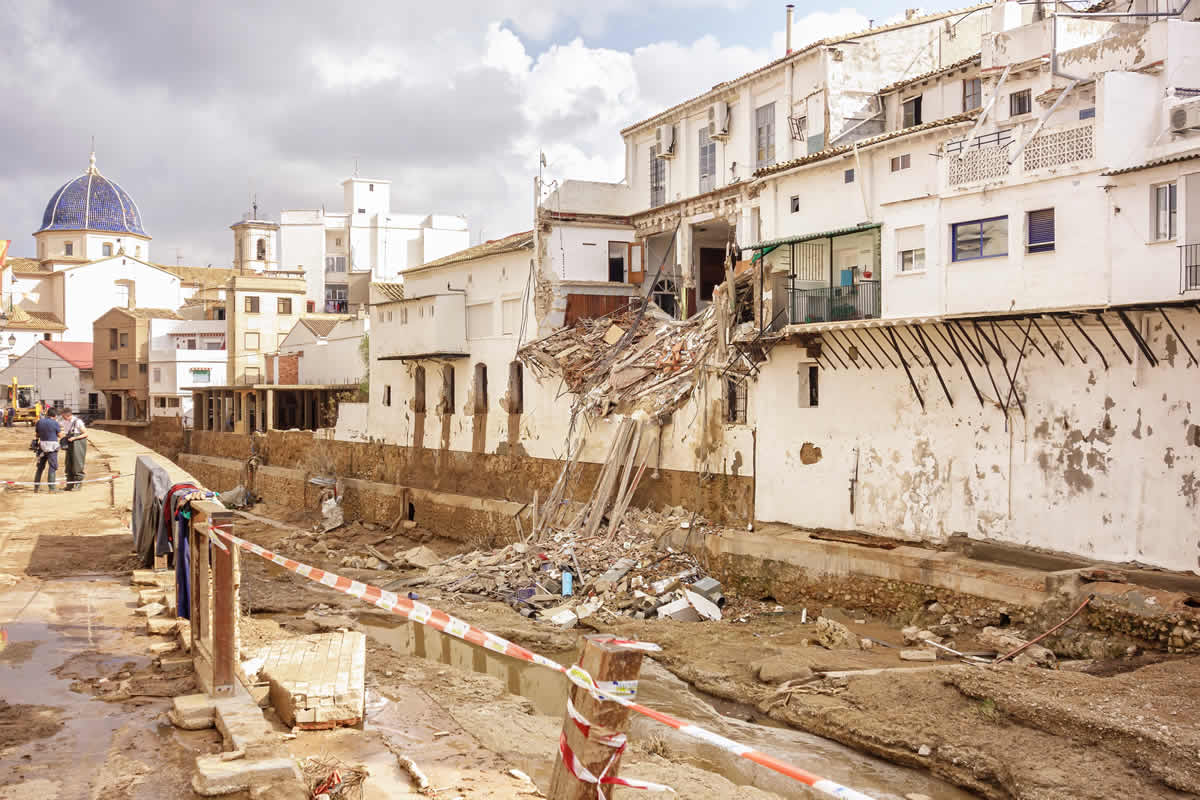
Floods in Valencia 2024

In 2024, severe floods in Europe and the UAE resulted in estimated insured losses of close to USD 13 billion to date. It was the third-costliest year for this threat globally and the second costliest for Europe, which experienced insured losses of approximately USD 10 billion, according to estimates in an annual review of natural disasters by Swiss Re Institute.

Intense precipitation in April caused floods in the Gulf region, disrupting the operations of the world’s busiest airport in Dubai. In September, Storm Boris caused major floods in Central Europe, mainly affecting the Czech Republic, Poland, and Austria. Additional impacts were reported from Slovakia, Romania, Italy, and Croatia. While so-called Vb lows – slow-moving, low-pressure systems – are nothing unusual in the region, the strong intensity of the Vb system connected to Storm Boris was favoured by conditions related to climate change. Storm Boris mixed cold Arctic air flowing southwards with unusually warm air from the east and south, drawing moisture from a record-breaking warm Mediterranean Sea.

In October, large parts of Spain experienced heavy rainfall, flash floods and hailstorms, which caused severe damage. The floods were worst in eastern and southern Spain, with most of the damage across the Valencia and Castilla-La Mancha regions. Andalusia and the Balearic Islands were also affected. One year’s average precipitation was dumped in less than eight hours in many locations. Steep clay terrain and drainage systems could not absorb the exceptional amount of water, leading to fast overflows.

Floods come in varied forms. The most common are fluvial and pluvial floods, and in coastal areas, storm surge floods. Fluvial floods can happen after periods of heavy rainfall. They usually affect areas close to rivers where flood waves can build up gradually or rapidly and last for a longer period. Pluvial floods can happen anywhere and affect all kinds of areas. Urban areas are at particular risk because large parts of soil are sealed and therefore cannot absorb the excess of water when drainage systems become overwhelmed.

Flood-related losses are likely to increase as climate change intensifies extreme weather events while asset values increase in high-risk areas due to urban sprawl. Adaptation is therefore key to resilience, says the Swiss Re Institute, and protective measures, such as dykes, dams, and flood gates, are up toten times more cost-effective than rebuilding.


Europe Middle East
Share. Facebook Twitter Pinterest LinkedIn Tumblr Email WhatsApp
Previous ArticleDRI International releases its Annual Risk and Resilience Trends report
Next Article Business risks are top of mind for organizational leaders around the world

Related Posts

A group of rabbits happily graze while a wolf watches, hidden in the bushes behind them.

Confidence in resilience is outpacing reality, according to new report

November 13, 2026
An upward trending arrow.

Organizations are being forced to rethink resilience strategies, finds State of IT Infrastructure Resilience study

November 13, 2026
Error page: 'This site can't be reached' message from a browser, indicating connection closed and suggesting checks (reload button visible).

Microsoft outage demonstrates the realities of concentration risks

November 13, 2026
The numbers 2027 with the 0 replaced with an AI symbol.

From hype to control: AI security, risk management, and governance in 2027

November 13, 2026
Geopolitical risks

Geopolitical conflict is increasingly reshaping how organizations manage people, operations, and risk

November 9, 2026
Abstract network of interconnected nodes and lines in blue.

Everbridge publishes its 2027 Global Risk & Resilience Outlook

November 9, 2026
Advertisement
Resilience First
This week's most read articles
AI agent in action concept.

Lack of clear activity baselines makes it harder to manage AI agent resilience and security

November 9, 2026
Two different jigsaw pieces.

KPMG Risk & Resilience Survey finds that half of organizations have yet to integrate risk and resilience management

March 12, 2025
Error page: 'This site can't be reached' message from a browser, indicating connection closed and suggesting checks (reload button visible).

Microsoft outage demonstrates the realities of concentration risks

November 13, 2026
Latest resources
An exploding digital padlock illustrates the requirement for post-quantum cryptography.

Board briefing: preparing for the post-quantum era

November 27, 2025
Load More

Subscribe to Updates

Get our Resilience Updates newsletter.

Most Popular Feature Articles
Five stage crisis management framework

A five stage framework for a crisis management process

Three dark coloured light bulbs on a black background illustrate the concept of The Dark Triad in Crisis Management.

The Dark Triad in crisis management

Blue interconnected gears and network nodes symbolizing automation and complex machinery.

Agent zero – the 2028 digital pandemic

Latest Reports
An AI agent icon lying on its side with eyes shut showing the concept of a deactivated agent.

New report reveals major operational resilience gaps in agentic AI adoption

Two hands form a rectangular frame around the sun in a bright sky over distant mountains.

BCI Future of Resilience Report points to a more strategic future for resilience

Global risks concept

UN report warns that the global risk landscape is being redrawn

A promo box for an article about resilience governance.
© 2026 Resilience Forward
  • About Resilience Forward
  • Newsletter
  • Newsfeed
  • Advertise
  • Call for Papers
  • Contact
  • Privacy Policy and Cookie Use
  • AI Use Policy

Type above and press Enter to search. Press Esc to cancel.

Manage Cookie Consent
To provide the best experiences, we use technologies like cookies to store and/or access device information. Consenting to these technologies will allow us to process data such as browsing behaviour or unique IDs on this site. Not consenting or withdrawing consent, may adversely affect certain features and functions.
Functional Always active
The technical storage or access is strictly necessary for the legitimate purpose of enabling the use of a specific service explicitly requested by the subscriber or user, or for the sole purpose of carrying out the transmission of a communication over an electronic communications network.
Preferences
The technical storage or access is necessary for the legitimate purpose of storing preferences that are not requested by the subscriber or user.
Statistics
The technical storage or access that is used exclusively for statistical purposes. The technical storage or access that is used exclusively for anonymous statistical purposes. Without a subpoena, voluntary compliance on the part of your Internet Service Provider, or additional records from a third party, information stored or retrieved for this purpose alone cannot usually be used to identify you.
Marketing
The technical storage or access is required to create user profiles to send advertising, or to track the user on a website or across several websites for similar marketing purposes.
  • Manage options
  • Manage services
  • Manage {vendor_count} vendors
  • Read more about these purposes
View preferences
  • {title}
  • {title}
  • {title}
Ad Blocker Enabled!
Ad Blocker Enabled!
Our website is made possible by displaying online advertisements to our visitors. Please support us by disabling your Ad Blocker.

Sign In or Register

Welcome Back!

Login to your account below.

Lost password?