Close Menu
  • Home
  • Managing resilience
    • AI resilience
    • Business continuity
    • Business resilience
    • Climate resilience
    • C-suite and the board
    • DORA – the EU Digital Operational Resilience Act
    • Operational resilience
    • Organizational resilience
    • Supply chain resilience
    • Technology
  • Risk
    • Enterprise risk management
    • Operational risk
    • Threatscape
  • Cyber resilience
    • Cyber resilience updates
    • DORA – the EU Digital Operational Resilience Act
    • Product updates
More items
  • All News
  • Research
  • Jobs in Resilience
  • Resilience Resources
  • About Resilience Forward
X (Twitter) LinkedIn
  • Home
  • Managing resilience
    • AI resilience
    • Business continuity
    • Business resilience
    • Climate resilience
    • C-suite and the board
    • DORA – the EU Digital Operational Resilience Act
    • Operational resilience
    • Organizational resilience
    • Supply chain resilience
    • Technology
  • Risk
    • Enterprise risk management
    • Operational risk
    • Threatscape
  • Cyber resilience
    • Cyber resilience updates
    • DORA – the EU Digital Operational Resilience Act
    • Product updates
Login
LinkedIn Bluesky
Resilience Forward
Subscribe Now
  • All News
  • Research
  • Jobs in Resilience
  • Resilience Resources
  • About Resilience Forward
Resilience Forward
You are at:Home»Managing resilience»Business continuity»Researchers demonstrate the use of smart microgrids to restore power in an outage (Page 4)
Business continuity

Researchers demonstrate the use of smart microgrids to restore power in an outage

UC Santa Cruz engineers have developed an AI model that optimizes the use of renewables and other energy sources to restore power when a main utility fails.
December 4, 20235 Mins Read
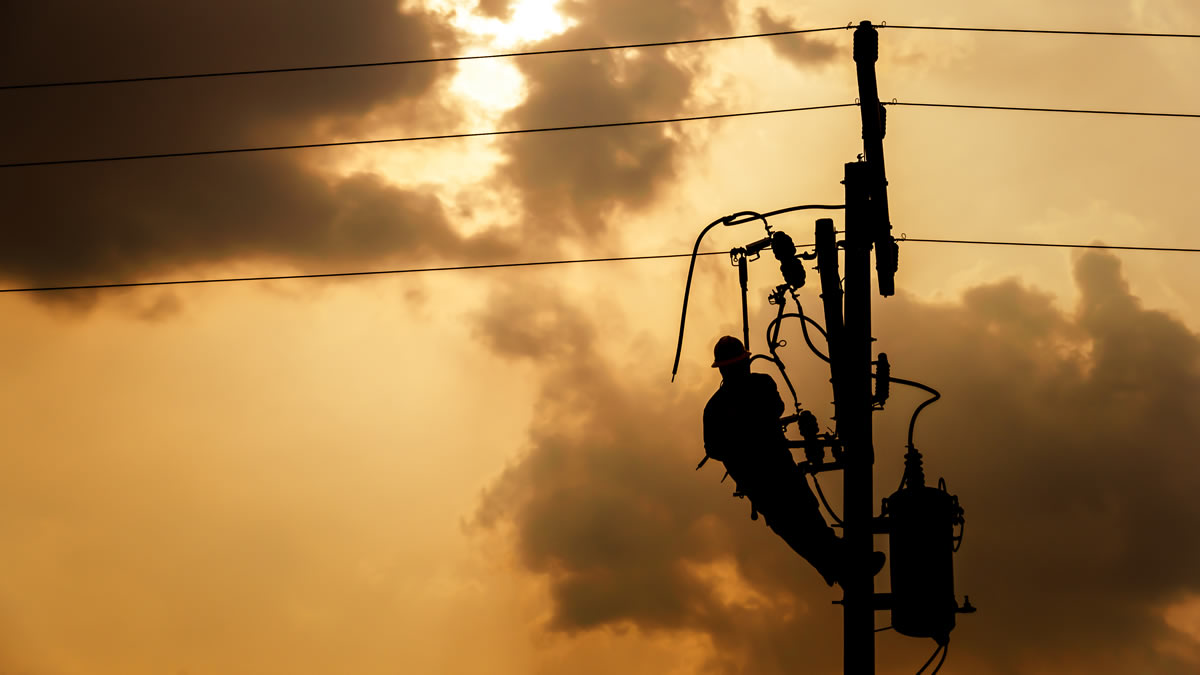
The silhouette of a power lineman climbing on an electric pole with a transformer installed. And replacing the damaged hotline clamp, bail clamp, dropout and surge arrester that causes a power failure.
#image_title

University of California, Santa Cruz Assistant Professor of Electrical and Computer Engineering Yu Zhang and his lab are leveraging tools to improve the efficiency, reliability, and resilience of power systems and have developed an artificial intelligence (AI) based approach for the smart control of microgrids for power restoration when outages occur. 

They describe their new AI model and show that it outperforms traditional power restoration techniques in a new paper published in the journal IEEE Transactions on Control of Network Systems. Network science. Shourya Bose, a Ph.D. student in Zhang’s lab, is the paper’s first author.

“Nowadays, microgrids are really the thing that both people in industry and in academia are focusing on for the future power distribution systems,” Zhang said.

In many communities, infrastructure and its users are totally reliant on a local power generating utility company for electricity. This means that in the case of a disaster or extreme weather event, or even just a tree falling on a line, power goes out until repairs can be made. 

Today, many electricity systems are smart in that they are interconnected with computers and sensors. They often incorporate local renewable energy sources such as rooftop solar panels or small wind turbines, and some buildings rely on backup generators and/or energy batteries for their electricity demand. 

This mix of power sources presents an opportunity to address outages locally by using alternative energy sources to provide electricity before upstream power is restored. One way to do this is with a microgrid, which distributes electricity to small areas such as a few buildings or a town — although the size of the microgrid can vary. 

The microgrid can be connected to the main power utility source, but also can function while disconnected in ‘islanding mode’, self-supported by alternate energy sources and unaffected by the issues impacting the main utility. Zhang’s research team focuses on optimizing how microgrids pull from these various alternate sources such as renewables, generators, and batteries to restore power quickly and correctly. 

Essentially, we want to bring the power generation closer to the demand side in order to get rid of the long transmission lines. This can improve the power quality and reduce the power losses over the lines. In this way, we will make the grid smaller, but stronger and more resilient.

Yu Zhang

To optimally operate microgrids, Zhang’s lab developed an AI-based technique called deep reinforcement learning, the same concept that underpins large language models, to create an efficient framework  that includes models of many components of the power system. Reinforcement learning depends on rewarding the algorithm for successfully responding to the changing environment  –  so an agent  is rewarded when it is able to successfully restore the demanded power of all components of the network. They explicitly model the practical constraints of the real-world system, such as the branch flows that power lines can handle.

We’re modeling a whole bunch of things – solar, wind, small generators, batteries, and we’re also modeling when people’s electricity demand changes. The novelty is that this specific flavor of reinforcement learning, which we call constrained policy optimization (CPO), is being used for the first time.

Shourya Bose

Their CPO approach takes into account real-time conditions and uses machine learning to find long-term patterns that affect the output of renewables, such as the varying demand on the grid at a given time and intermittent weather factors that affect renewable sources. This is unlike traditional systems which often use a technique called model predictive control (MPC) that bases decisions simply on the available conditions at the time of optimization. 

For example, if the CPO method predicts that the sun will shine brightly in an hour, it would use up its supply of solar energy with the knowledge that it will later be replenished – a different strategy than it might take if the day was cloudy. It can also learn about the system based on long-term patterns of how the grid uses solar.

The researchers found that their CPO technique significantly outperforms traditional MPC methods when the forecasts of renewable sources are lower than the reality because of its better understanding of all the possible solar profiles throughout any given day. 

They also found that the reinforcement learning controller is able to respond much faster than traditional optimization methods in the moment of a power outage. 

The research team recently proved the success of their method when they placed first in a global competition that invited participants to use reinforcement learning or similar techniques to operate a power grid. The competition, called L2RPN Delft 2023, was co-sponsored by France’s electricity transmission system operator (Réseau de Transport d’Électricité), which the UC Santa Cruz researchers see as an indicator that now large-scale grid operators may start moving toward AI and renewable energy techniques.

Now that they’ve developed a successful algorithm in simulations, the research team is working to test their model on microgrids in their lab. In the long-term, the researchers hope to implement their solution on the UC Santa Cruz campus’s energy system to address outage issues that the residential campus community faces. They also hope to see further interest and collaboration from industry.


Read the paper: Load Restoration in Islanded Microgrids: Formulation and Solution Strategies

North America
Share. Facebook Twitter Pinterest LinkedIn Tumblr Email WhatsApp
Previous ArticleHeads of ERM struggle to select and implement GRC tools
Next Article The top five cyber security and cloud native technology trends for 2024

Related Posts

An exploding digital padlock illustrates the requirement for post-quantum cryptography.

Research breakthrough brings reliable quantum computers and Q-day closer to reality

September 10, 2026
A danger sign on a digital background.

New blob URL phishing technique evades detection by using legitimate Microsoft services

September 10, 2026
AI risks

Unmanaged AI workflows expose EMEA organizations to rising compliance and data risks

September 9, 2026
City skyline at sunset with bright light trails and a translucent blue smart-city grid overlay and GPS pins indicating locations.

AI world models: future possibilities for organizational resilience?

September 7, 2026
DRJ and BCI logos

DRJ and BCI publish guidance for governing, managing, and using AI in resilience

September 7, 2026
Decision making with over whelming information.

AI can find the vulnerability. Accountability still sits with your crisis leadership

September 7, 2026
Advertisement
Resilience First
This week's most read articles
Under pressure: An egg cracking under pressure applied by squeezing clamps form the sides.

Managing scenario testing for operational resilience

May 16, 2024
COSO logo

New COSO ERM guidance aims to help organizations with practical implementation

May 12, 2026
Close-up of a green-brown iris peering through a jagged tear in dark paper or wall material.

The blind spots in business continuity

September 2, 2026
Latest resources
A woman with blonde hair and a ponytail looking at colourful sticky notes on a wall.

The stories behind the organization: how cultural narratives shape resilience

August 7, 2026
Load More

Subscribe to Updates

Get our Resilience Updates newsletter.

Most Popular Feature Articles
Three dark coloured light bulbs on a black background illustrate the concept of The Dark Triad in Crisis Management.

The Dark Triad in crisis management

Five stage crisis management framework

A five stage framework for a crisis management process

Blue interconnected gears and network nodes symbolizing automation and complex machinery.

Agent zero – the 2028 digital pandemic

Latest Reports
A futuristic red warning alert icon with glowing exclamation mark.

Cloud Security Alliance publishes Hugging Face Incident Initial Post-Mortem

A person hold a building door open for a person behind who is tailgating to get unauthorised access.

Security Culture: A Strategic Capability That Builds Resilience in a Volatile World

An identity icon with a map marker on it, indicating the concept of identity as a target for attackers. The icon is on a generic IT background predominantly in black and orange.

Identity-based approaches dominate initial access for ransomware attacks

A promo box for an article about resilience governance.
© 2026 Resilience Forward
  • About Resilience Forward
  • Newsletter
  • Newsfeed
  • Advertise
  • Call for Papers
  • Contact
  • Privacy Policy and Cookie Use
  • AI Use Policy

Type above and press Enter to search. Press Esc to cancel.

Manage Cookie Consent
To provide the best experiences, we use technologies like cookies to store and/or access device information. Consenting to these technologies will allow us to process data such as browsing behaviour or unique IDs on this site. Not consenting or withdrawing consent, may adversely affect certain features and functions.
Functional Always active
The technical storage or access is strictly necessary for the legitimate purpose of enabling the use of a specific service explicitly requested by the subscriber or user, or for the sole purpose of carrying out the transmission of a communication over an electronic communications network.
Preferences
The technical storage or access is necessary for the legitimate purpose of storing preferences that are not requested by the subscriber or user.
Statistics
The technical storage or access that is used exclusively for statistical purposes. The technical storage or access that is used exclusively for anonymous statistical purposes. Without a subpoena, voluntary compliance on the part of your Internet Service Provider, or additional records from a third party, information stored or retrieved for this purpose alone cannot usually be used to identify you.
Marketing
The technical storage or access is required to create user profiles to send advertising, or to track the user on a website or across several websites for similar marketing purposes.
  • Manage options
  • Manage services
  • Manage {vendor_count} vendors
  • Read more about these purposes
View preferences
  • {title}
  • {title}
  • {title}
Manage Cookie Consent
To provide the best experiences, we use technologies like cookies to store and/or access device information. Consenting to these technologies will allow us to process data such as browsing behaviour or unique IDs on this site. Not consenting or withdrawing consent, may adversely affect certain features and functions.
Functional Always active
The technical storage or access is strictly necessary for the legitimate purpose of enabling the use of a specific service explicitly requested by the subscriber or user, or for the sole purpose of carrying out the transmission of a communication over an electronic communications network.
Preferences
The technical storage or access is necessary for the legitimate purpose of storing preferences that are not requested by the subscriber or user.
Statistics
The technical storage or access that is used exclusively for statistical purposes. The technical storage or access that is used exclusively for anonymous statistical purposes. Without a subpoena, voluntary compliance on the part of your Internet Service Provider, or additional records from a third party, information stored or retrieved for this purpose alone cannot usually be used to identify you.
Marketing
The technical storage or access is required to create user profiles to send advertising, or to track the user on a website or across several websites for similar marketing purposes.
  • Manage options
  • Manage services
  • Manage {vendor_count} vendors
  • Read more about these purposes
View preferences
  • {title}
  • {title}
  • {title}
Ad Blocker Enabled!
Ad Blocker Enabled!
Our website is made possible by displaying online advertisements to our visitors. Please support us by disabling your Ad Blocker.

Sign In or Register

Welcome Back!

Login to your account below.

Lost password?



