Close Menu
  • Home
  • Managing resilience
    • AI resilience
    • Business continuity
    • Business resilience
    • Climate resilience
    • C-suite and the board
    • DORA – the EU Digital Operational Resilience Act
    • Operational resilience
    • Organizational resilience
    • Supply chain resilience
    • Technology
  • Risk
    • Enterprise risk management
    • Operational risk
    • Threatscape
  • Cyber resilience
    • Cyber resilience updates
    • DORA – the EU Digital Operational Resilience Act
    • Product updates
More items
  • All News
  • Research
  • Jobs in Resilience
  • Resilience Resources
  • About Resilience Forward
X (Twitter) LinkedIn
  • Home
  • Managing resilience
    • AI resilience
    • Business continuity
    • Business resilience
    • Climate resilience
    • C-suite and the board
    • DORA – the EU Digital Operational Resilience Act
    • Operational resilience
    • Organizational resilience
    • Supply chain resilience
    • Technology
  • Risk
    • Enterprise risk management
    • Operational risk
    • Threatscape
  • Cyber resilience
    • Cyber resilience updates
    • DORA – the EU Digital Operational Resilience Act
    • Product updates
Login
LinkedIn Bluesky
Resilience Forward
Subscribe Now
  • All News
  • Research
  • Jobs in Resilience
  • Resilience Resources
  • About Resilience Forward
Resilience Forward
You are at:Home»Cyber resilience»Majority of organizations experienced critical business function downtime as a result of a high-impact cyber event last year (Page 18)
Cyber resilience

Majority of organizations experienced critical business function downtime as a result of a high-impact cyber event last year

April 25, 20252 Mins Read
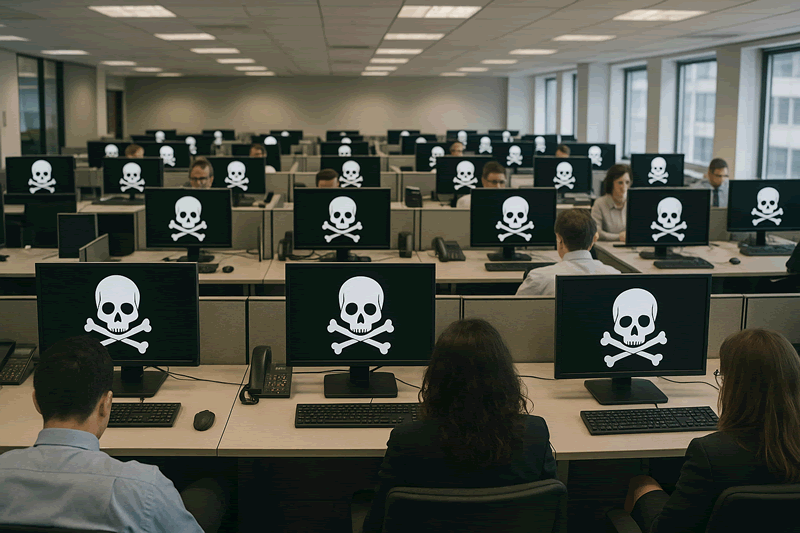
An office with a lot of workers at computer screens, each screen showing a skull to indicate a successful enterprise ransomware attack.

A new survey-based report from Semperis looks at The State of Enterprise Cyber Crisis Readiness. The survey of 1,000 organizations in the US, UK, Germany, France, Italy, Spain, Singapore, Australia, and New Zealand, found that 71% had experienced at least one high-impact cyber event that halted critical business functions last year.

In addition:

  • 36% suffered multiple high-impact events.
  • 96% of companies say they have a cyber crisis response plan.
  • 90% activated their enterprise crisis response plan at least once in the past year — some more than 25 times.
  • Only 10% report no blockers during incident response. Despite frequent testing, most organizations are not ‘battle-ready’ due to disjointed processes, poor coordination and tool sprawl.

The top five blockers to effective cyber response were:

  1. Cross-team communication gaps (48%)
  2. Out-of-date response plans (45%)
  3. Unclear roles and responsibilities (41%)
  4. Too many disparate tools (40%)
  5. Staffing shortages (ranked last globally at 39%)

There were regional differences apparent. Staffing shortages were listed as the biggest blocker in Italy and New Zealand. In the US, outdated response plans and cross-team communications gaps were ranked as the biggest blockers. In France and Germany, tool sprawl was the biggest blocker. Cross-team communications gaps was the top blocker in the UK, Australia, Singapore, and Spain.

IT/telecom industries experienced the most high-impact cyber events, followed by energy, travel/transportation, education and healthcare.

In today’s cyber threat landscape, the ability to respond swiftly and decisively is just as critical as prevention. Companies need a command centre for crisis management, ensuring organizations have the playbook, the training and the coordination needed to turn chaos into control.

Chris Inglis, US National Cyber Director and Semperis Strategic Advisor
Obtain the report

Alongside publishing the State of Enterprise Cyber Crisis Readiness report, Semperis announced the launch of Ready1, a first-of-its-kind enterprise resilience platform designed to bring structure, speed and coordination to cyber crisis management.

Ready1 unifies stakeholders, coordinators and technical teams under one secure platform, ensuring seamless crisis response through preparation, collaboration and enterprise-wide communications. It provides:

  • A secure command centre with live dashboards and playbook automation,
  • Real-time coordination across teams and external partners,
  • Integrated tools for communications, documentation and task tracking,
  • Always-on readiness through tabletop testing, role-based team building and after-action reviews.

Asia Pacific Australasia Europe North America UK
Share. Facebook Twitter Pinterest LinkedIn Tumblr Email WhatsApp
Previous ArticleThe 2025 Resilience Association Annual Summit
Next Article ‘Digital dexterity crisis’ threatens organizations’ ability to adapt to an AI centric business environment

Related Posts

An exploding digital padlock illustrates the requirement for post-quantum cryptography.

Research breakthrough brings reliable quantum computers and Q-day closer to reality

September 10, 2026
A danger sign on a digital background.

New blob URL phishing technique evades detection by using legitimate Microsoft services

September 10, 2026
AI risks

Unmanaged AI workflows expose EMEA organizations to rising compliance and data risks

September 9, 2026
City skyline at sunset with bright light trails and a translucent blue smart-city grid overlay and GPS pins indicating locations.

AI world models: future possibilities for organizational resilience?

September 7, 2026
DRJ and BCI logos

DRJ and BCI publish guidance for governing, managing, and using AI in resilience

September 7, 2026
Decision making with over whelming information.

AI can find the vulnerability. Accountability still sits with your crisis leadership

September 7, 2026
Advertisement
Resilience First
This week's most read articles
Under pressure: An egg cracking under pressure applied by squeezing clamps form the sides.

Managing scenario testing for operational resilience

May 16, 2024
COSO logo

New COSO ERM guidance aims to help organizations with practical implementation

May 12, 2026
Close-up of a green-brown iris peering through a jagged tear in dark paper or wall material.

The blind spots in business continuity

September 2, 2026
Latest resources
A hand completing a block puzzle with the word Resilience in the middle. The missing piece being added is an icon of chess pieces indicating strategic resilience governance.

Resilience governance: why do board members have a duty to consider resilience?

January 5, 2026
Load More

Subscribe to Updates

Get our Resilience Updates newsletter.

Most Popular Feature Articles
Three dark coloured light bulbs on a black background illustrate the concept of The Dark Triad in Crisis Management.

The Dark Triad in crisis management

Five stage crisis management framework

A five stage framework for a crisis management process

Blue interconnected gears and network nodes symbolizing automation and complex machinery.

Agent zero – the 2028 digital pandemic

Latest Reports
A futuristic red warning alert icon with glowing exclamation mark.

Cloud Security Alliance publishes Hugging Face Incident Initial Post-Mortem

A person hold a building door open for a person behind who is tailgating to get unauthorised access.

Security Culture: A Strategic Capability That Builds Resilience in a Volatile World

An identity icon with a map marker on it, indicating the concept of identity as a target for attackers. The icon is on a generic IT background predominantly in black and orange.

Identity-based approaches dominate initial access for ransomware attacks

A promo box for an article about resilience governance.
© 2026 Resilience Forward
  • About Resilience Forward
  • Newsletter
  • Newsfeed
  • Advertise
  • Call for Papers
  • Contact
  • Privacy Policy and Cookie Use
  • AI Use Policy

Type above and press Enter to search. Press Esc to cancel.

Manage Cookie Consent
To provide the best experiences, we use technologies like cookies to store and/or access device information. Consenting to these technologies will allow us to process data such as browsing behaviour or unique IDs on this site. Not consenting or withdrawing consent, may adversely affect certain features and functions.
Functional Always active
The technical storage or access is strictly necessary for the legitimate purpose of enabling the use of a specific service explicitly requested by the subscriber or user, or for the sole purpose of carrying out the transmission of a communication over an electronic communications network.
Preferences
The technical storage or access is necessary for the legitimate purpose of storing preferences that are not requested by the subscriber or user.
Statistics
The technical storage or access that is used exclusively for statistical purposes. The technical storage or access that is used exclusively for anonymous statistical purposes. Without a subpoena, voluntary compliance on the part of your Internet Service Provider, or additional records from a third party, information stored or retrieved for this purpose alone cannot usually be used to identify you.
Marketing
The technical storage or access is required to create user profiles to send advertising, or to track the user on a website or across several websites for similar marketing purposes.
  • Manage options
  • Manage services
  • Manage {vendor_count} vendors
  • Read more about these purposes
View preferences
  • {title}
  • {title}
  • {title}
Manage Cookie Consent
To provide the best experiences, we use technologies like cookies to store and/or access device information. Consenting to these technologies will allow us to process data such as browsing behaviour or unique IDs on this site. Not consenting or withdrawing consent, may adversely affect certain features and functions.
Functional Always active
The technical storage or access is strictly necessary for the legitimate purpose of enabling the use of a specific service explicitly requested by the subscriber or user, or for the sole purpose of carrying out the transmission of a communication over an electronic communications network.
Preferences
The technical storage or access is necessary for the legitimate purpose of storing preferences that are not requested by the subscriber or user.
Statistics
The technical storage or access that is used exclusively for statistical purposes. The technical storage or access that is used exclusively for anonymous statistical purposes. Without a subpoena, voluntary compliance on the part of your Internet Service Provider, or additional records from a third party, information stored or retrieved for this purpose alone cannot usually be used to identify you.
Marketing
The technical storage or access is required to create user profiles to send advertising, or to track the user on a website or across several websites for similar marketing purposes.
  • Manage options
  • Manage services
  • Manage {vendor_count} vendors
  • Read more about these purposes
View preferences
  • {title}
  • {title}
  • {title}
Ad Blocker Enabled!
Ad Blocker Enabled!
Our website is made possible by displaying online advertisements to our visitors. Please support us by disabling your Ad Blocker.

Sign In or Register

Welcome Back!

Login to your account below.

Lost password?



