
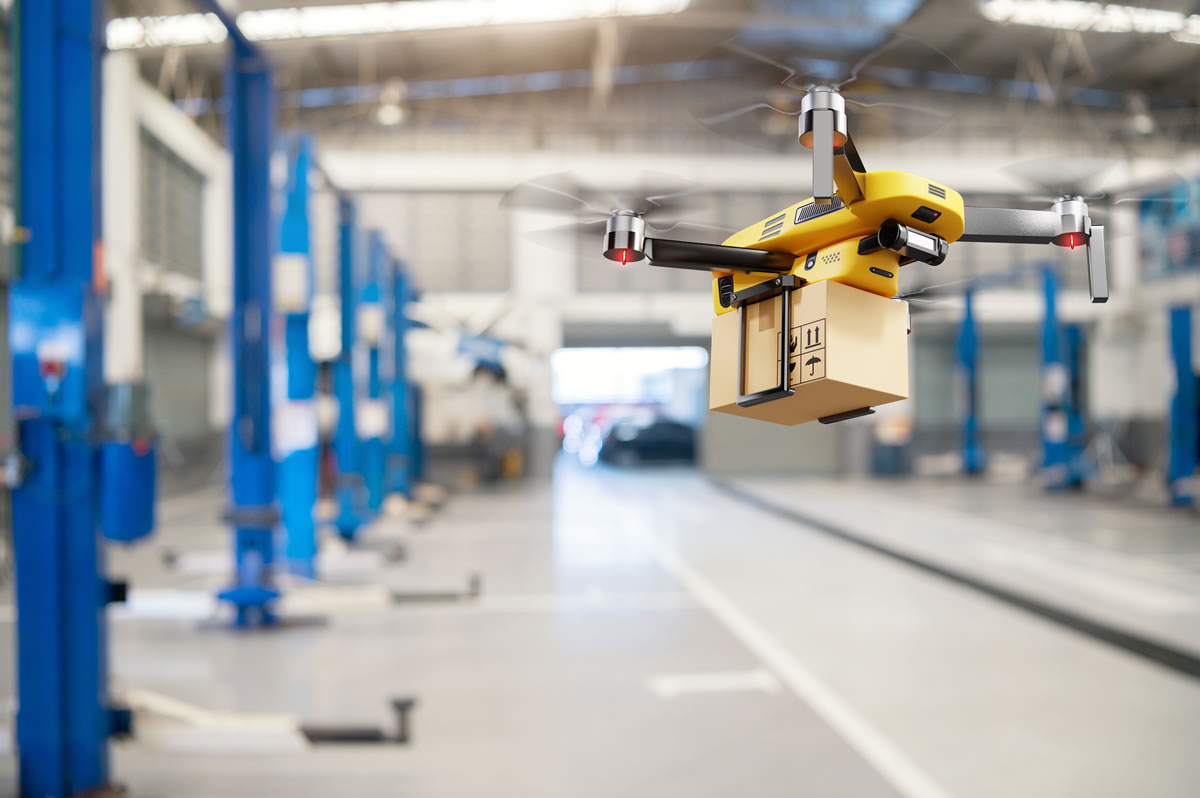
With the growth of drone delivery services, there are now over 2,000 commercial drone deliveries every day worldwide, but have risk management techniques kept pace? A new paper throws some light on this area.
As drones work collaboratively in swarms cybersecurity risks are becoming increasingly prominent. Drone swarms rely on data sharing to perform task scheduling and this highly interconnected communication mode means that an attack on one node could trigger a chain reaction across the entire network.
To address this challenge, a recent study by a team of researchers from the School of Mathematical and Statistical Sciences, Arizona State University, proposed a dynamic percolation model. It is based on probabilistic graph theory and spatial Poisson point processes, comprehensively modeling the loss distribution of cybersecurity risks across various scales of drone delivery networks.
By analyzing both single-layer and multi-layer models, the study evaluates the upper bounds of losses for drone swarms and turret networks under cyberattacks, considering different system parameters such as signal strength, communication range, and node vulnerability.
Simulation results indicate that with lower network percolation risks, optimized allocation of defense resources and improved communication protocols can significantly reduce losses; conversely, in cases of high percolation probability, losses tend to increase.
Notably, these findings, published in the Risk Sciences paper ‘Cyber risk loss distribution for various scale drone delivery systems’, not only offers theoretical and practical support for cybersecurity risk assessments in drone delivery services, but also provides guidance for policymakers, risk management experts, and cybersecurity professionals in optimizing defense strategies.





