Close Menu
  • Home
  • Managing resilience
    • AI resilience
    • Business continuity
    • Business resilience
    • Climate resilience
    • C-suite and the board
    • DORA – the EU Digital Operational Resilience Act
    • Operational resilience
    • Organizational resilience
    • Supply chain resilience
    • Technology
  • Risk
    • Enterprise risk management
    • Operational risk
    • Threatscape
  • Cyber resilience
    • Cyber resilience updates
    • DORA – the EU Digital Operational Resilience Act
    • Product updates
More items
  • All News
  • Research
  • Jobs in Resilience
  • Resilience Resources
  • About Resilience Forward
X (Twitter) LinkedIn
  • Home
  • Managing resilience
    • AI resilience
    • Business continuity
    • Business resilience
    • Climate resilience
    • C-suite and the board
    • DORA – the EU Digital Operational Resilience Act
    • Operational resilience
    • Organizational resilience
    • Supply chain resilience
    • Technology
  • Risk
    • Enterprise risk management
    • Operational risk
    • Threatscape
  • Cyber resilience
    • Cyber resilience updates
    • DORA – the EU Digital Operational Resilience Act
    • Product updates
Login
LinkedIn Bluesky
Resilience Forward
Subscribe Now
  • All News
  • Research
  • Jobs in Resilience
  • Resilience Resources
  • About Resilience Forward
Resilience Forward
You are at:Home»Risk»Threatscape»Avian influenza study by University of Maryland raises concerns of an increasing risk of another pandemic (Page 13)
Threatscape

Avian influenza study by University of Maryland raises concerns of an increasing risk of another pandemic

First major global review of avian influenza in cats shows an emerging source for a future human pandemic.
May 8, 20253 Mins Read
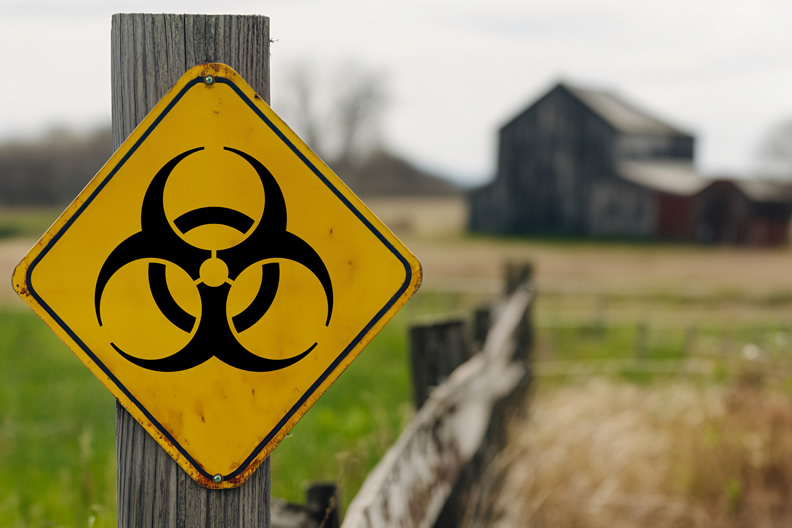
Yellow biohazard warning sign at fence with farm with animals infected with H5N1 virus in background.

On May 7 2025, researchers from the University of Maryland School of Public Health published an open access paper in Open Forum Infectious Diseases documenting research on avian influenza in cats and calling for urgent surveillance of cats to help avoid human-to-human transmission.

“The virus has evolved, and the way that it jumps between species – from birds to cats, and now between cows and cats, cats and humans – is very concerning. As summer approaches, we are anticipating cases on farms and in the wild to rise again,” says lead and senior author Dr. Kristen Coleman, assistant professor in UMD School of Public Health’s Department of Global, Environmental and Occupational Health and affiliate professor in UMD’s Department of Veterinary Medicine.  

“Bird flu is very deadly to cats, and we urgently need to figure out how widespread the virus is in cat populations to better assess spillover risk to humans,” she said. “We want to help protect both people and pets.” 

Spanning data from 2004 through 2024, the global review of research papers found 607 avian influenza infections in cats, including 302 associated deaths, from 18 countries and in 12 types of cat species, from pet cats to tigers. Cats are not actively monitored for avian influenza and testing is usually performed postmortem, if at all. Due to the lack of surveillance, the numbers are likely a significant underestimate, Coleman said. 

Yet the ways cats are getting  avian influenza are multiplying. The study shows cats contract avian influenza directly by eating infected birds or contaminated raw chicken feed, and indirectly through other mammals – for example, farm cats fed raw milk from infected cows, pet cats to other pet cats, tigers to other tigers. 

Infected cats often suffer from acute encephalitis (brain swelling) and other severe symptoms, which are mistaken for rabies, according to the study. The most deadly strain of avian influenza, H5N1, is highly infectious and makes up the majority of cases in domestic cats, with a current 90% case fatality rate. In humans, avian influenza is slightly less deadly, but still has killed around half of the 950 people infected with it globally. Between April 28, 2022 (when cumulative data on humans in the U.S. started being collected) and January 6, 2025, the United States has seen 66 confirmed cases in humans and one death. 

There are no reported cases of human to human transmission of avian influenza, but researchers are concerned that as the virus spreads and evolves, it could become easily transmissible through the air. 

“Our future research will involve studies to determine the prevalence of HPAI and other influenza viruses in high-risk cat populations such as dairy barn cats. Our research seeks to protect people and our vulnerable pet cats from the emerging threat of H5N1,” said Ian Gill Bemis, coauthor of the paper and doctoral student studying avian influenza in cats.  

Funding for this project was provided by the University of Maryland Baltimore, Institute for Clinical & Translational Research (ICTR) and the University of Maryland Strategic Partnership: MPowering the State (MPower) to KKC, as well as discretionary funding from the University of Maryland School of Public Health, Department of Global, Environmental, and Occupational Health to KKC.


Read the paper

Africa Asia Asia Pacific Australasia Europe Middle East North America UK
Share. Facebook Twitter Pinterest LinkedIn Tumblr Email WhatsApp
Previous ArticleSocial engineering reported to be the root cause of recent cyber attacks on high profile UK retailers
Next Article Uptime Institute releases Annual Outage Analysis 2025 report: looks at IT and data center outage trends

Related Posts

An exploding digital padlock illustrates the requirement for post-quantum cryptography.

Research breakthrough brings reliable quantum computers and Q-day closer to reality

September 10, 2026
A danger sign on a digital background.

New blob URL phishing technique evades detection by using legitimate Microsoft services

September 10, 2026
AI risks

Unmanaged AI workflows expose EMEA organizations to rising compliance and data risks

September 9, 2026
City skyline at sunset with bright light trails and a translucent blue smart-city grid overlay and GPS pins indicating locations.

AI world models: future possibilities for organizational resilience?

September 7, 2026
DRJ and BCI logos

DRJ and BCI publish guidance for governing, managing, and using AI in resilience

September 7, 2026
Decision making with over whelming information.

AI can find the vulnerability. Accountability still sits with your crisis leadership

September 7, 2026
Advertisement
Resilience First
This week's most read articles
Under pressure: An egg cracking under pressure applied by squeezing clamps form the sides.

Managing scenario testing for operational resilience

May 16, 2024
COSO logo

New COSO ERM guidance aims to help organizations with practical implementation

May 12, 2026
Close-up of a green-brown iris peering through a jagged tear in dark paper or wall material.

The blind spots in business continuity

September 2, 2026
Latest resources
Corporate Governance Guiding Principles for Board Oversight cover

COSO releases guidance for board risk management and internal control oversight

April 8, 2026
Load More

Subscribe to Updates

Get our Resilience Updates newsletter.

Most Popular Feature Articles
Three dark coloured light bulbs on a black background illustrate the concept of The Dark Triad in Crisis Management.

The Dark Triad in crisis management

Five stage crisis management framework

A five stage framework for a crisis management process

Blue interconnected gears and network nodes symbolizing automation and complex machinery.

Agent zero – the 2028 digital pandemic

Latest Reports
A futuristic red warning alert icon with glowing exclamation mark.

Cloud Security Alliance publishes Hugging Face Incident Initial Post-Mortem

A person hold a building door open for a person behind who is tailgating to get unauthorised access.

Security Culture: A Strategic Capability That Builds Resilience in a Volatile World

An identity icon with a map marker on it, indicating the concept of identity as a target for attackers. The icon is on a generic IT background predominantly in black and orange.

Identity-based approaches dominate initial access for ransomware attacks

A promo box for an article about resilience governance.
© 2026 Resilience Forward
  • About Resilience Forward
  • Newsletter
  • Newsfeed
  • Advertise
  • Call for Papers
  • Contact
  • Privacy Policy and Cookie Use
  • AI Use Policy

Type above and press Enter to search. Press Esc to cancel.

Manage Cookie Consent
To provide the best experiences, we use technologies like cookies to store and/or access device information. Consenting to these technologies will allow us to process data such as browsing behaviour or unique IDs on this site. Not consenting or withdrawing consent, may adversely affect certain features and functions.
Functional Always active
The technical storage or access is strictly necessary for the legitimate purpose of enabling the use of a specific service explicitly requested by the subscriber or user, or for the sole purpose of carrying out the transmission of a communication over an electronic communications network.
Preferences
The technical storage or access is necessary for the legitimate purpose of storing preferences that are not requested by the subscriber or user.
Statistics
The technical storage or access that is used exclusively for statistical purposes. The technical storage or access that is used exclusively for anonymous statistical purposes. Without a subpoena, voluntary compliance on the part of your Internet Service Provider, or additional records from a third party, information stored or retrieved for this purpose alone cannot usually be used to identify you.
Marketing
The technical storage or access is required to create user profiles to send advertising, or to track the user on a website or across several websites for similar marketing purposes.
  • Manage options
  • Manage services
  • Manage {vendor_count} vendors
  • Read more about these purposes
View preferences
  • {title}
  • {title}
  • {title}
Manage Cookie Consent
To provide the best experiences, we use technologies like cookies to store and/or access device information. Consenting to these technologies will allow us to process data such as browsing behaviour or unique IDs on this site. Not consenting or withdrawing consent, may adversely affect certain features and functions.
Functional Always active
The technical storage or access is strictly necessary for the legitimate purpose of enabling the use of a specific service explicitly requested by the subscriber or user, or for the sole purpose of carrying out the transmission of a communication over an electronic communications network.
Preferences
The technical storage or access is necessary for the legitimate purpose of storing preferences that are not requested by the subscriber or user.
Statistics
The technical storage or access that is used exclusively for statistical purposes. The technical storage or access that is used exclusively for anonymous statistical purposes. Without a subpoena, voluntary compliance on the part of your Internet Service Provider, or additional records from a third party, information stored or retrieved for this purpose alone cannot usually be used to identify you.
Marketing
The technical storage or access is required to create user profiles to send advertising, or to track the user on a website or across several websites for similar marketing purposes.
  • Manage options
  • Manage services
  • Manage {vendor_count} vendors
  • Read more about these purposes
View preferences
  • {title}
  • {title}
  • {title}
Ad Blocker Enabled!
Ad Blocker Enabled!
Our website is made possible by displaying online advertisements to our visitors. Please support us by disabling your Ad Blocker.

Sign In or Register

Welcome Back!

Login to your account below.

Lost password?