
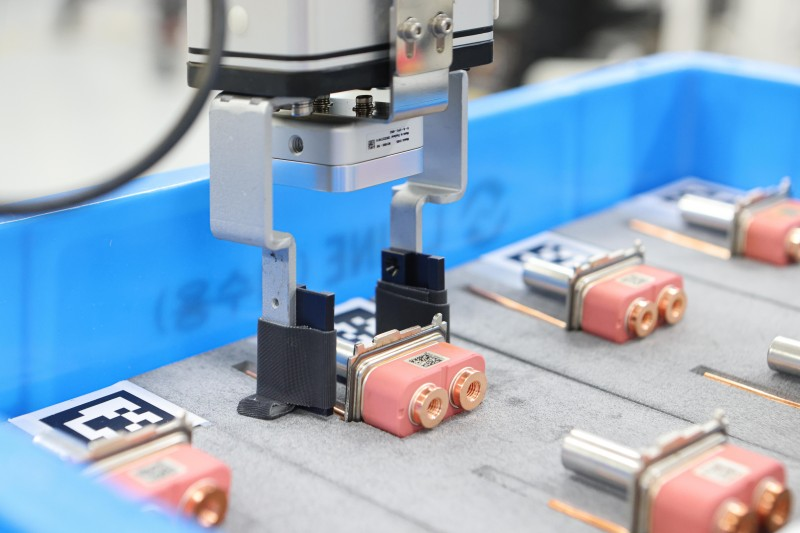
An AI technology for robot work, which allows robots to be easily applied to manufacturing processes, has been developed for the first time. The newly developed technology has a variety of direct uses within manufacturing processes as well as offering resilience opportunities.
The new technology is currently being applied to the manufacturing processes of electronic component producers and the research team plans to gradually expand the scope of manufacturers to which the newly developed technology can be applied. These are expected to be a variety of processes such as the manufacturing of automobiles and machine parts, as well as assembly and production.
The AI technology for robot work at manufacturing sites is based on the Large Language Model (LLM) and a virtual environment. This offers a way for the robot to understand the user’s commands and automatically execute the commands for the tasks that need to be performed.
Using this technology, task sequences and movements can be automatically generated via voice or text; and the optimal work point for the site can be selected through pre-learning in a virtual space. Meanwhile, the technology also helps to optimise the work process and to automatically detect objects and avoid collisions.
Until now, when a robot is used for performing tasks at a manufacturing site, the site itself needed to be modified to suit the robot rather than the work environment or the object. Therefore, the scope of the tasks that can be performed by robot has been quite restricted.
AI technologies such as LLM have been combined with robots before and used for performing various tasks. However, it has been difficult to apply these technologies to actual sites, because tests are conducted only in a laboratory environment, not at the actual work site.
By using the newly developed technology, it is possible to specify the task to be performed by the robot. Moreover, by carrying out pre-learning in a virtual space, the robot is capable of easily performing its tasks with minimal on-site modification. As on-site demonstration tests are currently being conducted, it is expected that the newly developed technology will help to effectively respond to various situations that may occur at manufacturing sites in the future.
The research team was led by Chang-hyun Kim, head of the Department of AI Machinery of the Korea Institute of Machinery and Materials (KIMM).





