
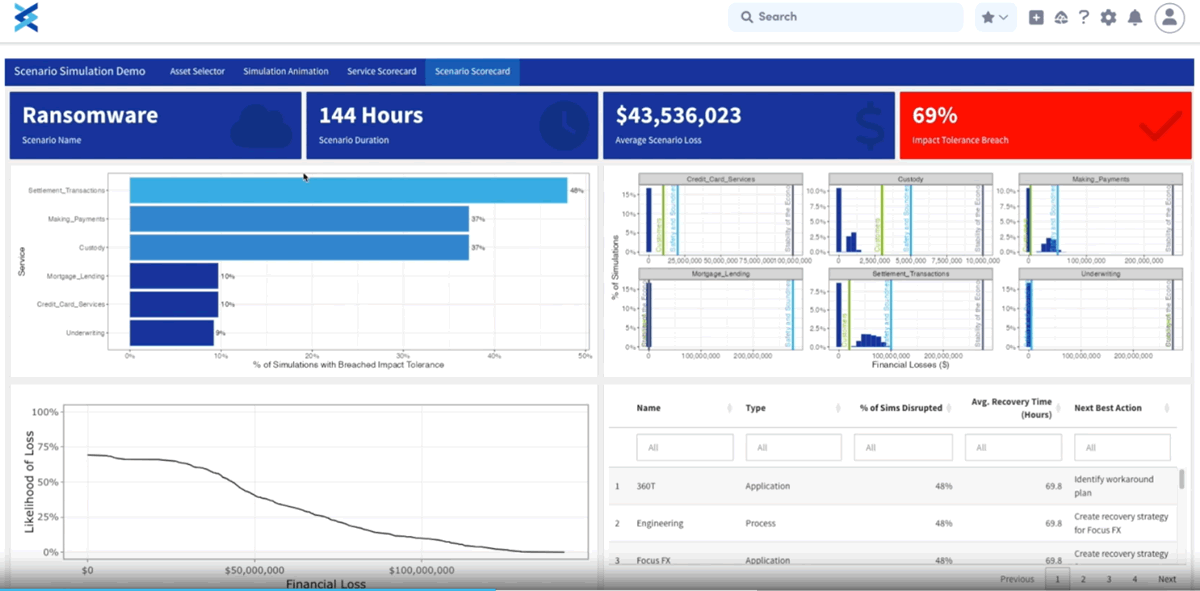
Fusion Risk Management has announced the launch of its new Scenario Simulation and Intelligence suite. These new capabilities allow companies to simulate thousands of possible scenarios against their resilience plans and strategies in order to identify points of weakness at scale and to develop severe but plausible scenarios for operational resilience assurance.
Fusion says that ‘with thousands of data points and thousands of risks, there are many thousands of possible outcomes for any scenario – meaning that it has never before been possible to truly test your resilience approaches to their limits. Now, for the first time ever, businesses will have the best opportunity to know what could occur, how they will be impacted, and how to best respond no matter how a disruption unfolds.’
“What we have heard from our customers is that they want to know – and many now need to know to prove to regulators – where their organization could break during their next disruption. With the complexity of most businesses, it has been nearly impossible for teams to identify every vulnerability and test them to the limit – until now. Scenario Simulation and Intelligence is the answer,” said Michael Campbell, Chief Executive Officer, Fusion Risk Management. “This solution represents a significant leap forward in resilience technology. By harnessing the power of AI and businesses’ own data in their Fusion instance, organizations can stress test their operations against a multitude of scenarios, uncover hidden vulnerabilities, and make data-driven decisions to strengthen their resilience.”
With Scenario Simulation and Intelligence, Fusion customers will be able to:
- Run thousands of severe but plausible scenarios concurrently to uncover previously unknown weak points in resilience plans along with gaps in systems, processes, and data. This will help users understand where the organization is most vulnerable and prioritize focus.
- Test more scenarios with less effort: across multiple scenarios and based on the data in their Fusion instance, customers can know what could occur, the potential impact, and what to fix or have a plan for to ensure the best response possible to disruptions.
- Innovative, proprietary generative AI suggests what Fusion customers should test, identifies their organization’s most important vulnerabilities, and recommends improvements.
- Improve ‘less than perfect’ data: if data is incomplete or not trusted, instead of calling out vulnerabilities, simulations identify data gaps in business impact analysis, risk, and plan data while prioritizing what to fix first.
- Increase engagement with enhanced tabletops: assess organizational resilience prior to a tabletop, then prioritize what scenarios to test with the correct individuals participating.





